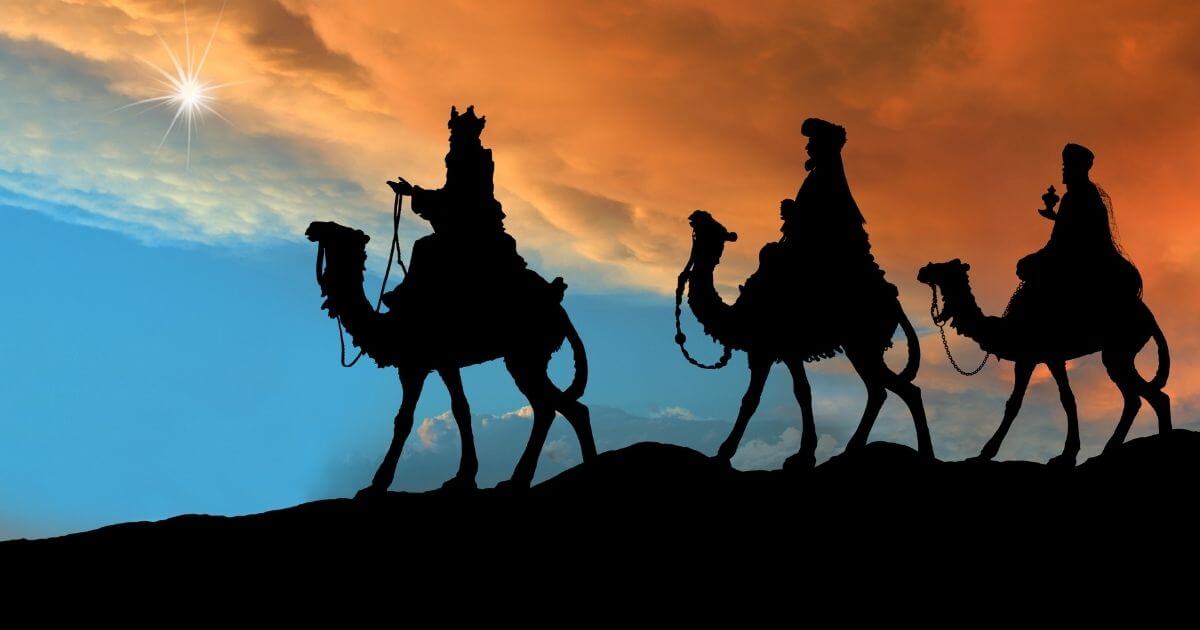
Were there three wise men who came to Jesus' birth?

Were there three wise men who came to Jesus' birth?
Redemption The Bible People in the Bible

TL;DR:

The Bible doesn’t specify that there were three wise men—Matthew only records that some magi visited Jesus and brought three gifts. This uncertainty reminds us to stick to Scripture’s truth and keep our focus where it belongs: on Jesus Himself.

from the old testament

  • The magi at Jesus' birth is not recorded in the Old Testament.

from the new testament

  • The account of the “wise men” (magi) appears only in Matthew 2:1–12, not the other gospels. The word translated as “wise men” is plural, so we know that there were at least two, but the passage gives no specific number.
  • The tradition of three magi stems from the three gifts they brought to Jesus (Matthew 2:11). Readers assumed that the gifts of gold, frankincense, and myrrh implied one gift per man. However, the passage indicates only that they brought three gifts, not that there was one gift per magi. More or fewer than three of them could have presented the gifts.
  • The magi did not visit Jesus at His birth. They came after following “his star” in the sky (Matthew 2:2), the same time the angels appeared to local shepherds (Luke 2:18-14). Herod's later order to kill children two years and younger (Matthew 2:16) implies that the time between the star’s appearance and the Magi’s arrival was roughly two years.
  • Other support in the passage that suggests a later arrival is that they visited “the house,” not “the stable" (Matthew 2:11). While there, they “saw the child,” not “the infant” (Matthew 2:9, 11). This implies that Mary and Joseph had moved to a more suitable place and that some time had passed, so Jesus was now a young child. Careful reading of the passage implies that Jesus was one to two years old when the magi arrived.

implications for today

Christmas is a great time of year to remember and celebrate the birth of Jesus. It’s a holiday that comes with many traditions, whether it’s listening to Bing Crosby, decorating a tree, or even shopping. Included in those traditions are accounts of Jesus’ birth, some of which imaginatively stretch beyond Scripture. The idea of the three wise men is an example. We know for certain that wise men (magi) visited and that they brought three gifts. However, it is from tradition, not Scripture, that we have come to believe there were specifically three wise men.

What are we to do in cases like this, where a Christmas tradition embellishes Scripture? Simply put, we are to be humble and be willing to forsake tradition for what Scripture teaches. Our love for the Christmas stories or nativity scenes should never undermine the most important truth: Jesus was born to be the Savior of the world.

The magi traveled a long way because they realized the significance of His birth. Do you?

Before Jesus came, sinful humanity faced only God’s fierce, eternal justice against His rebellious creation. But in love, He sent His Son to die in their place (John 3:16–17). What made Jesus’ birth so significant was that God had entered into humanity by the Son taking on human flesh. He became like us in every way except without sin (Hebrews 4:15). He then willingly went to the cross to die to take the Father’s just wrath upon Himself. Thus, Jesus’ birth indicated the arrival of the Father’s sacrifice for sin. By repenting of your sin and confessing Jesus as Lord, you will receive that sacrifice as well (Romans 10:9–10). This is why the angels sang, “On earth peace among those with whom he is pleased” (Luke 2:14b). God had offered peace to all who would repent.

understand

  • The Bible records that magi visited Jesus, but it never states how many there were.
  • The tradition of the three wise men likely developed because three gifts are mentioned.
  • The magi probably visited Jesus sometime after His birth, when He was already living in a house.

reflect

  • How does separating biblical details from traditions help you read Scripture more carefully?
  • How does the journey of the magi inspire you to actively seek and respond to God’s revelation in your own life?
  • In what ways can you shift your attention from secondary details to the main message of God’s Word, especially regarding Jesus’ life and mission?

engage

  • How can we respectfully guide others who strongly cling to traditions that go beyond Scripture?
  • What can Christians do to promote truth over tradition?
  • How does the story of the magi highlight God’s plan for Jesus to be recognized and worshiped by people from every nation?